Autonomous Drones: How Commercial UAVs Are Transforming Delivery, Infrastructure, and Emergency Response in 2026
- Internet Pros Team
- March 8, 2026
- AI & Technology
In February 2026, a 74-year-old woman living in a remote Appalachian community received her insulin delivery in 12 minutes — not from a driver navigating winding mountain roads, but from a Zipline autonomous drone that flew 18 miles over rugged terrain at 70 miles per hour. The same week, a Skydio X10 drone autonomously inspected 40 miles of aging power lines in rural Texas, detecting seven critical defects that human inspectors had missed for months. Meanwhile, Wing — Alphabet's drone delivery subsidiary — completed its 500,000th commercial delivery in Dallas-Fort Worth, dropping off everything from prescriptions to tacos in under 10 minutes. These are not pilot programs or press stunts. In 2026, autonomous commercial drones have crossed the threshold from experimental technology to essential infrastructure, reshaping logistics, public safety, agriculture, and industrial operations at a scale few predicted even two years ago.
The Commercial Drone Market in 2026: Growth Beyond Expectations
The global commercial drone market has reached a size and velocity that would have seemed implausible at the start of the decade. According to Drone Industry Insights, the market is projected to surpass 54 billion dollars in 2026, growing at a compound annual rate of 13.9 percent. More significantly, the composition of that market has shifted dramatically. Hardware sales — once the dominant revenue driver — now account for less than 35 percent. The majority of value comes from software, autonomy platforms, and drone-as-a-service (DaaS) operations, reflecting a mature industry where the real differentiation lies not in flying machines but in the artificial intelligence that controls them.
Regulatory progress has been the critical enabler. The FAA's expanded Beyond Visual Line of Sight (BVLOS) rules, finalized in late 2025, allow certified operators to fly autonomous missions without a human pilot maintaining visual contact with the aircraft. This single regulatory change unlocked the economics of commercial drone operations — enabling one operator to manage fleets of dozens of drones simultaneously rather than the one-pilot-per-drone model that had constrained the industry for years. The European Union Aviation Safety Agency (EASA) and aviation authorities in Japan, South Korea, Australia, and the UAE have enacted similar frameworks, creating a global regulatory environment that finally supports autonomous drone commerce at scale.
"BVLOS authorization was the dam break the industry had been waiting for. It fundamentally changed the unit economics of drone operations — what was a $200-per-flight human-in-the-loop cost became a $12-per-flight autonomous operation. That is when every logistics company, utility, and emergency service started taking drones seriously."
Last-Mile Delivery: The Race to Your Doorstep
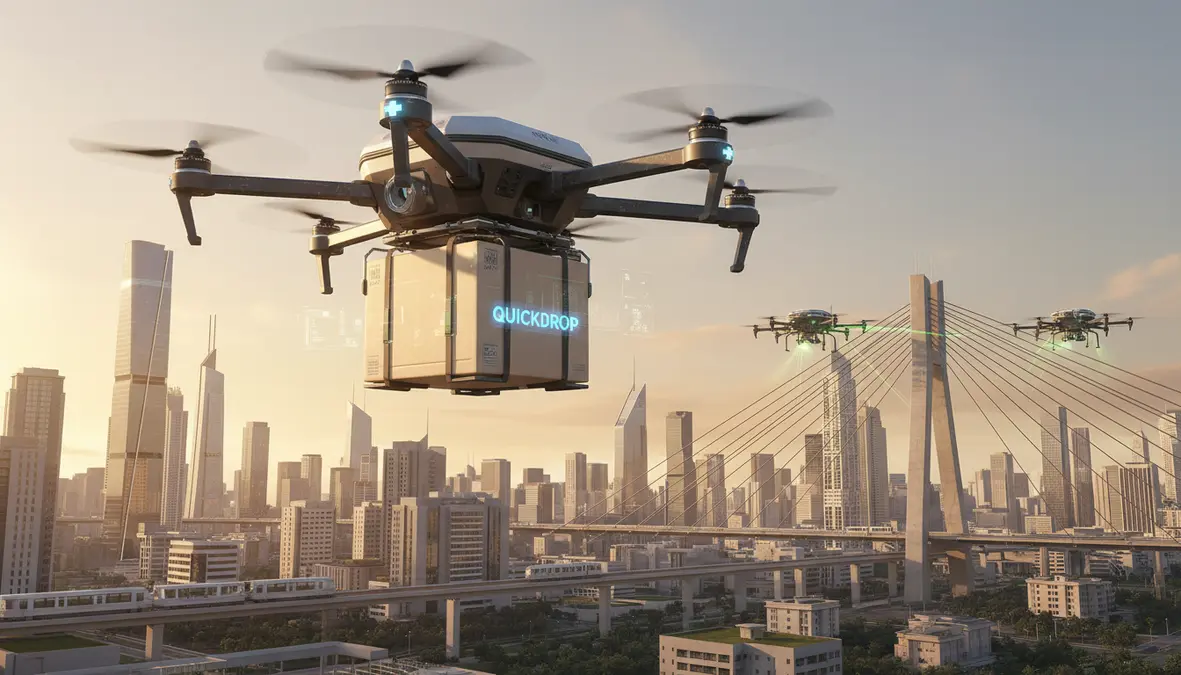
Drone delivery has moved from novelty to necessity in specific market segments. Wing, Zipline, and Amazon Prime Air are now operating commercial delivery networks across multiple metropolitan areas and rural corridors in the United States, with expanding operations in Europe, Africa, and Asia-Pacific.
Wing's operations in the Dallas-Fort Worth metroplex have become the template for urban drone delivery. Their drones service a 12-mile radius, delivering packages weighing up to 5.5 pounds in an average of 8 minutes from order to doorstep. The company reports that drone deliveries produce 97 percent fewer carbon emissions than equivalent car-based deliveries and cost approximately 60 percent less at scale. In 2026, Wing expanded to Austin, Phoenix, and three cities in France, with plans for 15 additional markets by year-end.
Zipline has carved out an entirely different niche. Originally founded to deliver blood and medical supplies in Rwanda, the company has evolved into the world's largest autonomous delivery operator by flight volume. Their Platform 2 drones — which lower packages on a tether from a precise hover rather than landing — complete over 1,000 deliveries per day across their US and African operations. Walmart, the company's largest retail partner, now offers Zipline drone delivery from over 50 stores, with plans to reach 200 by the end of 2026.
| Operator | Range | Payload | Delivery Time | Active Markets (2026) |
|---|---|---|---|---|
| Wing (Alphabet) | 12 miles | 5.5 lbs | ~8 minutes | US, Australia, Finland, France |
| Zipline | 50 miles | 4.4 lbs (P2) | ~12 minutes | US, Rwanda, Ghana, Nigeria, Kenya |
| Amazon Prime Air | 8 miles | 5 lbs | ~30 minutes | US (College Station, Lockeford, Phoenix) |
| Meituan | 6 miles | 6.6 lbs | ~15 minutes | China (Shenzhen, Shanghai, Beijing) |
Infrastructure Inspection: Seeing What Humans Cannot
Perhaps the most economically impactful application of autonomous drones in 2026 is infrastructure inspection. Bridges, power lines, wind turbines, cell towers, pipelines, and solar farms all require regular inspection — work that has traditionally been dangerous, expensive, and infrequent. Autonomous drones are transforming this calculus by making inspections safer, cheaper, and dramatically more thorough.
Skydio's X10 platform has become the industry standard for autonomous infrastructure inspection. The drone uses AI-powered visual navigation to fly complex inspection paths around structures without GPS — navigating under bridges, between power lines, and inside confined spaces that would be impossible for manually piloted drones. Its onboard AI processes imagery in real-time, flagging corrosion, cracks, vegetation encroachment, and thermal anomalies and generating actionable reports before the drone even lands.
Energy and Utilities
Major utilities including Duke Energy, Pacific Gas and Electric, and National Grid have deployed autonomous drone fleets to inspect transmission lines, substations, and solar installations. PG&E reports that drone inspections are 10 times faster and 80 percent cheaper than traditional helicopter-based methods, while detecting defects at a 40 percent higher rate. During wildfire season, drones provide real-time monitoring of high-risk power lines — a capability that has already prevented multiple potential ignition events.
Transportation Infrastructure
The US Department of Transportation now mandates drone-assisted inspection for all federally funded bridge projects. Autonomous drones equipped with LiDAR and high-resolution cameras create detailed 3D models of bridge structures, identifying stress fractures, rebar corrosion, and concrete delamination that visual inspection alone would miss. Several state DOTs report reducing bridge inspection costs by 65 percent while increasing inspection frequency from biennial to quarterly.
Emergency Response: Minutes That Save Lives
Autonomous drones have become indispensable tools for first responders. Fire departments, search and rescue teams, law enforcement agencies, and disaster relief organizations are deploying drones as standard equipment — not as supplementary gadgets but as first-on-scene assets that arrive before ground units and provide critical situational awareness.
The Chula Vista Police Department in California — a pioneer in drone-as-first-responder (DFR) programs — now launches an autonomous drone to nearly every priority call. The drone arrives on scene in an average of 90 seconds, streaming live video to dispatchers and responding officers. The department reports that in over 30 percent of calls, the drone's aerial perspective resolves the situation without requiring a ground unit, freeing officers for higher-priority work. Over 500 law enforcement agencies in the US now operate DFR programs, with adoption accelerating rapidly.
In disaster response, drones have moved from supplementary to essential. During the 2025 hurricane season, FEMA deployed autonomous drone swarms to map flood damage, locate stranded survivors, and deliver emergency supplies to cut-off communities. Thermal imaging drones located 47 survivors in collapsed structures during a single deployment, operations that would have taken ground teams days to accomplish.
The AI Brain Behind Autonomous Flight
The technology enabling this commercial drone revolution is not primarily about better aircraft — it is about better artificial intelligence. Modern autonomous drones rely on sophisticated AI systems that combine computer vision, sensor fusion, path planning, and real-time decision-making to operate safely in complex, unpredictable environments.
Core AI Technologies Powering Autonomous Drones
- Visual-inertial odometry (VIO): Combines camera feeds with inertial sensors to maintain precise position awareness without GPS, enabling reliable flight in GPS-denied environments like urban canyons, under bridges, and inside buildings.
- Detect-and-avoid (DAA) systems: AI-powered systems that identify and avoid obstacles, other aircraft, birds, and moving objects in real-time, satisfying regulatory safety requirements for autonomous BVLOS operations.
- Semantic scene understanding: Deep learning models that interpret the drone's environment — distinguishing between a landing pad, a person, a vehicle, a power line, and a tree — enabling context-appropriate behavior.
- Fleet orchestration AI: Cloud-based systems that coordinate dozens or hundreds of drones simultaneously, optimizing routes, managing airspace deconfliction, balancing battery life, and dynamically rerouting around weather or temporary flight restrictions.
- Edge AI processing: On-board neural processing units that handle real-time inference for obstacle avoidance and inspection analysis without requiring cloud connectivity, critical for operations in remote areas or emergency scenarios.
Challenges and the Road Ahead
Despite remarkable progress, significant challenges remain. Public acceptance varies widely — surveys show that while 72 percent of Americans support drone delivery in concept, concerns about noise, privacy, and safety persist, particularly in dense residential areas. Noise reduction technology has improved substantially, with newer drones operating at under 50 decibels at delivery altitude, but the perception challenge remains real.
Airspace integration is the most complex technical and regulatory challenge. As drone traffic increases, the FAA's Unmanned Aircraft System Traffic Management (UTM) framework must scale to handle hundreds of thousands of simultaneous flights. The agency is working with NASA and private partners including AirMap and Iris Automation to develop the digital infrastructure needed for safe, high-density drone operations — effectively building an air traffic control system for low-altitude autonomous flight.
Weather resilience also remains a limitation. Most commercial drones cannot operate safely in sustained winds above 25 miles per hour, heavy rain, or icing conditions. Companies like Zipline and Joby are pushing the boundaries with weather-hardened designs, but seasonal weather patterns still cause significant operational disruptions in many markets.
What This Means for Your Business
The autonomous drone revolution is creating opportunities far beyond the companies building and flying the aircraft. Businesses in logistics, construction, real estate, insurance, agriculture, energy, and telecommunications are finding that drone data and drone-delivered services can reduce costs, improve safety, and unlock capabilities that were previously impractical. Whether you need aerial imagery for property assessment, autonomous inspection of physical assets, rapid delivery capabilities for time-sensitive products, or AI-powered analysis of drone-captured data, the technology is mature and the economics are compelling.
At Internet Pros, we help businesses integrate drone technology with their existing software systems — building custom dashboards for drone fleet management, developing AI models for automated inspection analysis, creating APIs that connect drone data with enterprise platforms, and designing the cloud infrastructure needed to process and store the massive datasets that autonomous drone operations generate. Contact us today to explore how autonomous drone technology can give your business a competitive edge in 2026 and beyond.