AI in Education: How Personalized Learning and Intelligent Tutoring Are Reshaping Schools and Universities in 2026
- Internet Pros Team
- March 4, 2026
- AI & Technology
In September 2025, a school district in Atlanta made national headlines when its AI-powered tutoring program helped eighth-grade students improve standardized math scores by 38 percent in a single academic year. The same month, Stanford University reported that students using its AI teaching assistant completed coursework 30 percent faster while scoring higher on comprehension tests. These are not isolated experiments — they are signals of a fundamental transformation underway in global education. In 2026, artificial intelligence is no longer a futuristic promise for classrooms. It is actively reshaping how students learn, how teachers teach, and how institutions measure success.
The Crisis That Made AI in Education Inevitable
The global education system has been under mounting pressure for years. Teacher shortages have reached crisis levels across the United States, United Kingdom, and European Union, with the US alone facing a deficit of over 300,000 certified educators. Class sizes are growing while per-student instructional time shrinks. Standardized testing reveals persistent achievement gaps across socioeconomic, racial, and geographic lines. Meanwhile, the COVID-19 pandemic exposed the fragility of traditional educational models and accelerated the adoption of digital learning tools by an estimated decade.
The core problem is one of scale: truly effective education requires personalized attention — understanding each student's strengths, weaknesses, pace, and preferred learning style. A classroom teacher managing 30 or more students simply cannot provide individualized instruction to every learner. This is precisely where artificial intelligence excels — processing vast amounts of data about individual performance to deliver customized learning experiences at scale.
"AI will not replace teachers, but teachers who use AI will replace those who don't. The technology's greatest contribution to education is giving every student what only the wealthiest have always had: a personal tutor who knows exactly what they need and when they need it."
How AI-Powered Personalized Learning Works
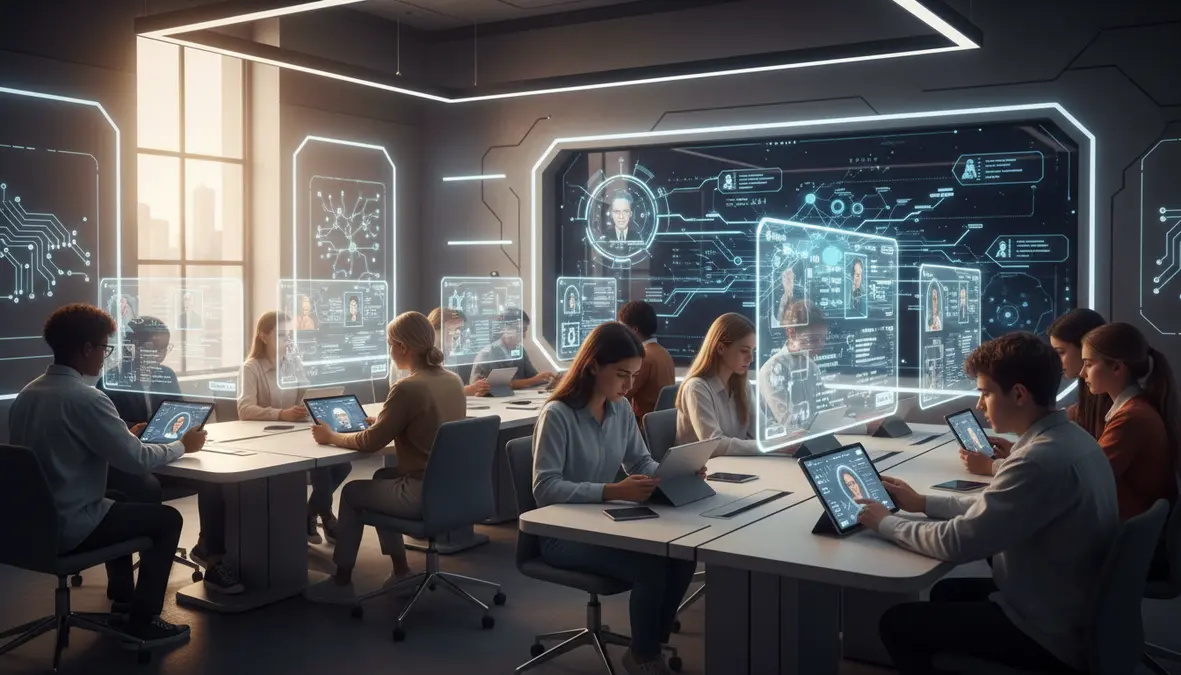
Modern AI learning platforms use a combination of machine learning algorithms, natural language processing, and learning analytics to create individualized educational experiences. These systems continuously assess student knowledge through micro-assessments, analyze response patterns, identify knowledge gaps, and dynamically adjust content difficulty, pacing, and instructional approach in real time.
Adaptive Content Delivery
AI systems like DreamBox, Carnegie Learning, and Knewton analyze thousands of data points per student session — time spent on problems, error patterns, hint usage, and topic mastery levels — to dynamically select the next concept, adjust difficulty, and choose the most effective instructional format (video, interactive exercise, text explanation, or peer collaboration).
Intelligent Tutoring Systems
Platforms like Khan Academy's Khanmigo, Duolingo Max, and Squirrel AI provide one-on-one tutoring conversations powered by large language models. These AI tutors can explain concepts in multiple ways, use Socratic questioning to guide discovery, generate practice problems tailored to specific weaknesses, and provide instant detailed feedback — available 24/7 at no additional cost.
The EdTech Platforms Leading the Revolution
Several platforms have emerged as leaders in AI-driven education, each approaching the challenge from a different angle but sharing the common goal of making high-quality, personalized instruction accessible to every learner.
| Platform | AI Capability | Target Audience | Key Metric |
|---|---|---|---|
| Khan Academy Khanmigo | AI tutor, lesson planning, writing coach | K-12 students and teachers | Used by 5M+ students across 15,000 schools |
| Duolingo Max | AI conversation partner, adaptive exercises | Language learners worldwide | 40% faster fluency acquisition vs. traditional methods |
| Squirrel AI | Nano-level knowledge mapping, adaptive paths | K-12 students (China, expanding globally) | Tutored 10M+ students with 5-10x efficiency gains |
| Carnegie Learning MATHia | Step-by-step AI math coaching | Middle and high school math | 23% improvement in algebra proficiency |
| Coursera AI Coach | Personalized course recommendations, AI grading | Higher education and professionals | 35% increase in course completion rates |
AI Teaching Assistants: Augmenting Educators
One of the most impactful applications of AI in education is not student-facing at all — it is teacher-facing. AI teaching assistants are handling the administrative burden that consumes an estimated 50 percent of educators' working hours: grading assignments, generating lesson plans, creating differentiated materials for students at different levels, identifying at-risk students, and communicating with parents.
Georgia State University pioneered the use of an AI advising chatbot called Pounce that proactively reaches out to students showing signs of disengagement — missed assignments, declining grades, or reduced login frequency. The system reduced summer enrollment melt by 22 percent and has since been adopted by over 300 universities. In K-12 settings, tools like Gradescope use AI to grade handwritten assignments and exams, reducing grading time by up to 70 percent while maintaining consistency across hundreds of submissions.
- Automated grading and feedback: AI systems grade essays, math problems, and code submissions with accuracy comparable to human graders, providing instant detailed feedback that students can act on immediately rather than waiting days or weeks.
- Curriculum design: Tools like Education Copilot and Diffit generate standards-aligned lesson plans, worksheets, and assessments in minutes, allowing teachers to focus on instruction and student relationships.
- Early intervention: Predictive analytics identify students at risk of falling behind or dropping out weeks before traditional indicators, enabling proactive intervention.
- Language accessibility: Real-time AI translation and text simplification make educational content accessible to English language learners and students with reading difficulties.
AI-Powered Assessment: Beyond Standardized Testing
Traditional assessment — multiple-choice tests administered at fixed intervals — captures only a narrow snapshot of student knowledge. AI is enabling a shift toward continuous, formative assessment that measures understanding in real time as students learn. Platforms like Alchemy and Roshi analyze student interactions, discussion contributions, and problem-solving approaches to build comprehensive competency profiles without the stress and artificiality of high-stakes testing.
Universities are also using AI for academic integrity. Tools like Turnitin's AI detection and GPTZero help educators distinguish between student-written and AI-generated work, while simultaneously encouraging the development of AI literacy policies that teach students to use these tools responsibly rather than prohibiting them outright.
Challenges and Ethical Considerations
The rapid adoption of AI in education is not without significant concerns. Privacy is paramount — AI learning systems collect enormous amounts of data about children's cognitive patterns, learning behaviors, and performance history. The US Department of Education and EU regulators have issued updated guidelines requiring strict data minimization, parental consent, and algorithmic transparency for EdTech platforms used in schools.
Key Challenges for AI in Education
- Data Privacy: Student data protection under FERPA, COPPA, and GDPR requires rigorous safeguards, especially for systems processing children's behavioral and cognitive data.
- Algorithmic Bias: AI systems trained on non-diverse datasets risk reinforcing existing achievement gaps. Continuous bias auditing and diverse training data are essential.
- Digital Divide: AI-powered learning requires reliable internet access and modern devices — resources still unavailable to millions of students worldwide.
- Over-Reliance: Educators and policymakers must ensure AI augments human instruction rather than replacing the social, emotional, and mentoring aspects of teaching that technology cannot replicate.
What This Means for Schools, Universities, and Businesses
The AI education revolution extends well beyond K-12 and university classrooms. Corporate training and professional development programs are rapidly adopting the same AI-driven personalization techniques. Companies using AI-powered learning platforms like Cornerstone, Docebo, and LinkedIn Learning report 25 to 60 percent reductions in training time and significantly higher knowledge retention. In a world where skill requirements change faster than traditional curricula can adapt, AI-driven continuous learning is becoming a competitive necessity for organizations of every size.
At Internet Pros, we help educational institutions and businesses build AI-powered learning solutions tailored to their specific needs. Whether you are looking to implement an intelligent tutoring system, develop a custom adaptive learning platform, or integrate AI teaching assistants into your existing infrastructure, our team has the expertise to bring your vision to life. Contact us today to discuss how AI can transform learning outcomes for your students, employees, or customers.